Compare · OES Spectrometers
Exquis T4 vs Innovate T5 — JIEBO benchtop OES comparison
Both the Exquis T4 and Innovate T5 are JIEBO benchtop spark OES instruments built on the same 401 mm Paschen-Runge optics. The T4 is the budget-and-space-conscious choice — 33 kg, sealed argon recirculation, 4 base matrices — and serves a single-matrix QC workflow. The T5 trades footprint for capability: a vacuum optical chamber, wider 140–680 nm window and 10 base matrices, suitable for plants that need multi-alloy coverage on one instrument.
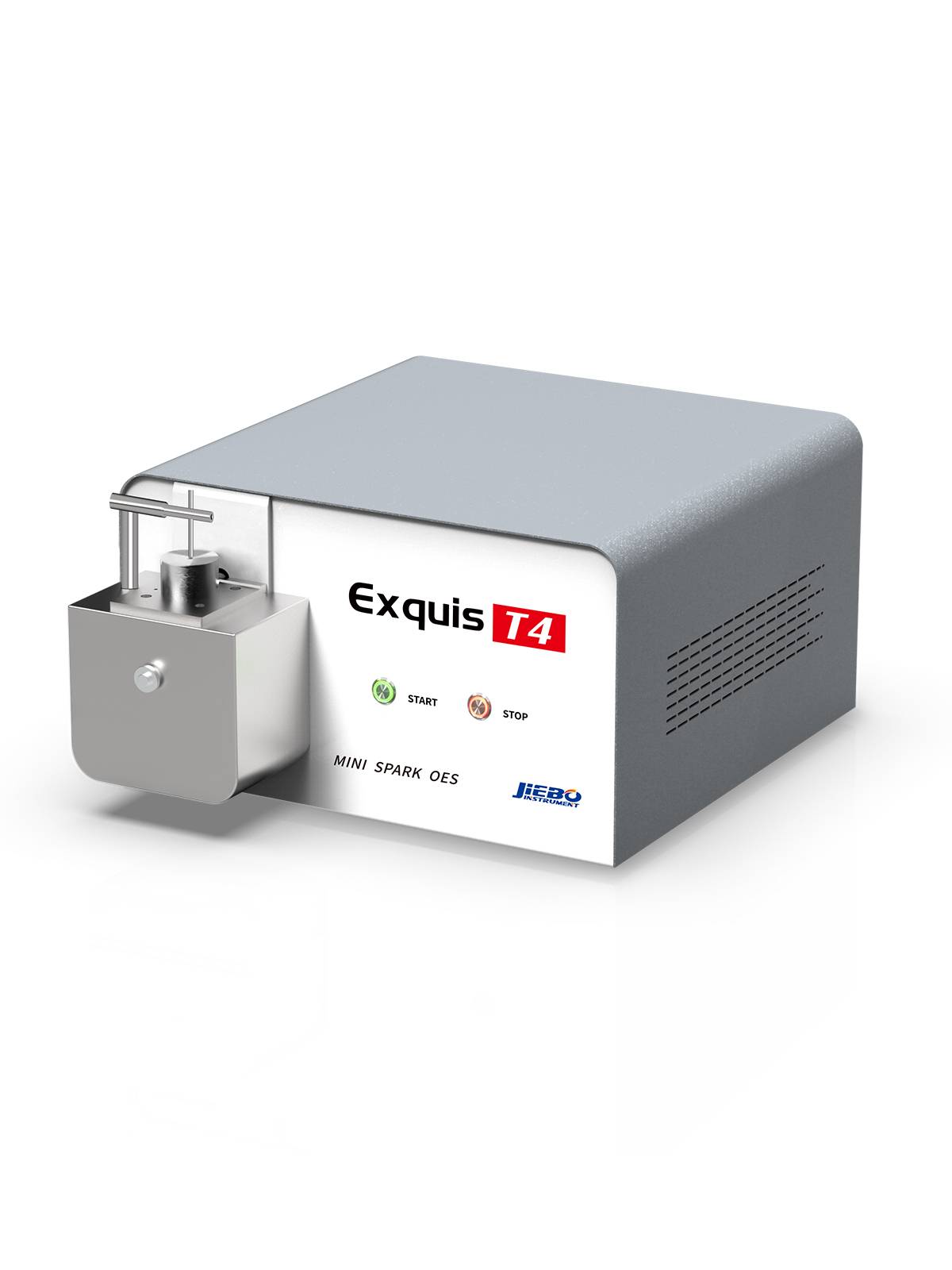
JIEBO-T4
Exquis T4
Entry-level benchtop OES — 33 kg, sealed-cycle argon, 4 base matrices
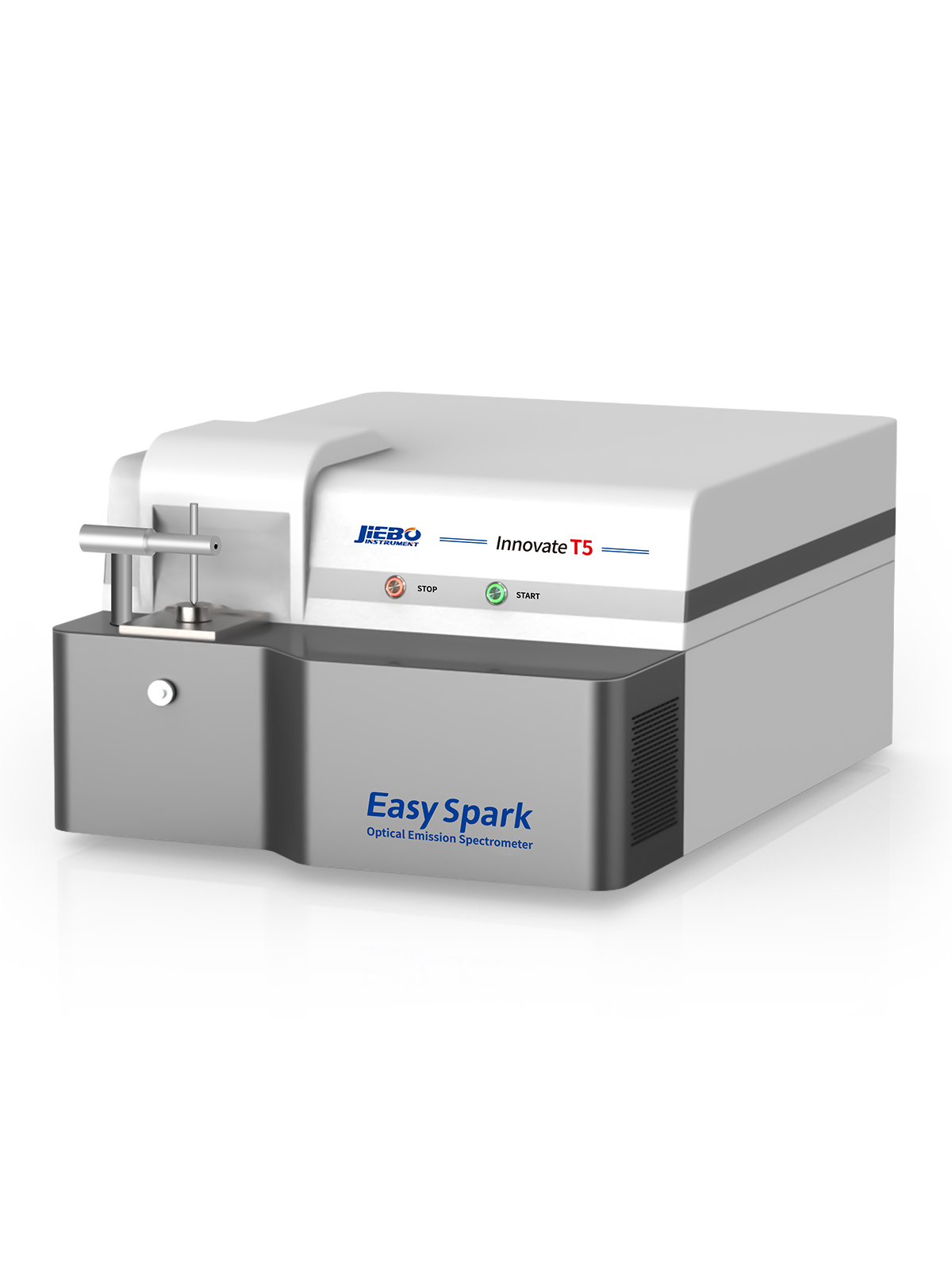
JIEBO-T5
Innovate T5
Production-floor workhorse — 78 kg, vacuum chamber, 10 base matrices
Specifications
| Exquis T4 | Innovate T5 | |
|---|---|---|
| Optical system | Sealed-cycle argon chamber | Vacuum optical chamber |
| Wavelength range | 160–580 nm | 140–680 nm |
| Detector | Low-noise integrated CMOS | Hamamatsu CMOS, per-channel config |
| Base matrices | Fe, Al, Cu, Zn (4 base) | Fe, Al, Cu, Mg, Zn, Ni, Co, Ti, Sn, Pb (10 base) |
| Dimensions (L × W × H) | 525 × 635 × 290 mm | 590 × 790 × 350 mm |
| Weight | 33 kg | 78 kg |
| Best for | Furnace-side single-matrix QC | Multi-alloy production QC |
When to choose which
Choose Exquis T4 when
- Budget is the deciding constraint and your workflow centres on a single matrix (Fe, Al, Cu or Zn)
- You need furnace-side or rolling-cart deployment — 33 kg is one-person installable
- Argon supply is expensive or restricted and the sealed-cycle chamber materially lowers monthly consumption
- You only need standard 160–580 nm coverage; trace elements below the T4 window are not part of your method
Choose Innovate T5 when
- Your plant runs multiple alloy families (steel, aluminum, copper, magnesium, nickel) and needs one instrument to cover all
- You need the wider 140–680 nm range — important for elements like Mg, Ti, Sn, Pb and trace work
- Vacuum optics rather than sealed argon are mandated by your QA method or the customer specification
- Production volume justifies a 78 kg permanent QC station instead of a portable benchtop
Frequently asked questions
Can a T4 calibration be moved to a T5?
Calibration curves don't port directly — the T5 has a different optical chamber (vacuum vs sealed argon) and a wider wavelength range. The chemistry knowledge and operator training transfer fully, but expect re-standardisation when migrating a method.
How different is argon consumption?
The T4's sealed-cycle chamber uses noticeably less argon for routine work — useful in regions where 5N argon is expensive or hard to source. The T5 vacuum chamber still uses argon for the spark, but the chamber itself does not need continuous flushing.
Which is faster per measurement?
Both run a typical single-sample analysis in roughly the same time (tens of seconds). The T5 advantage is broader element coverage in one burn, not raw speed.
I'm on a tight budget but might need more matrices in 2–3 years. Which do I buy?
Buy the T4 if budget is the binding constraint today — it pays back faster. When the multi-matrix need is real, the T5 typically arrives as a second instrument while the T4 stays on for incoming inspection.