Compare · OES Spectrometers
Innovate T5 vs Noble T7 — JIEBO OES spectrometer comparison
Both the Innovate T5 and Noble T7 are full-spectrum JIEBO OES spectrometers built on the same 401 mm Paschen-Runge optics. They serve different buyers: the T5 is optimised for daily production-floor QC at moderate weight and footprint, while the T7 trades portability for a wider 120–800 nm window, a constant-temperature optical chamber, and research-grade trace-element accuracy. The right choice depends on whether your bottleneck is sample throughput or analytical precision.
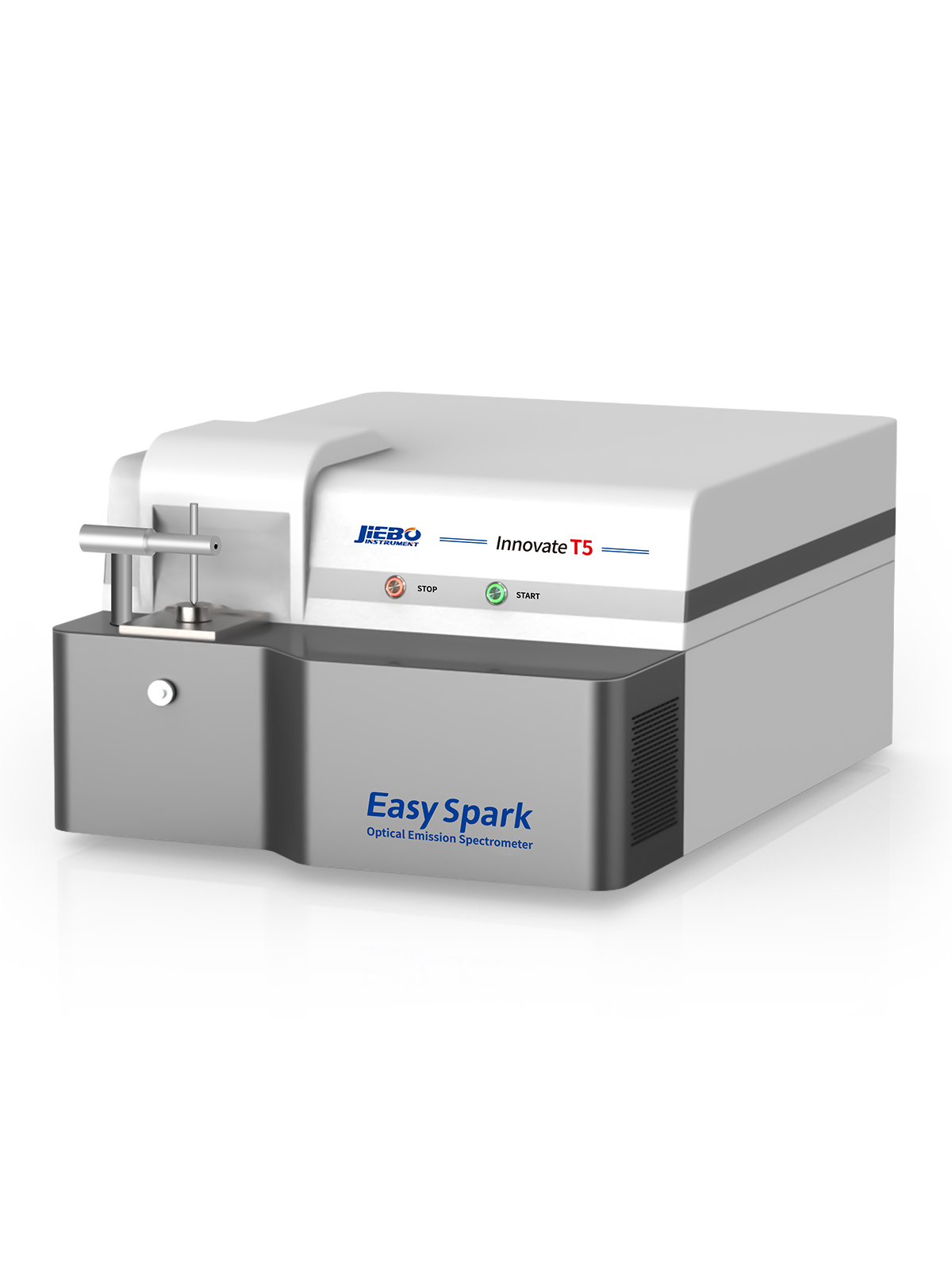
JIEBO-T5
Innovate T5
Production-floor workhorse — vacuum chamber, 78 kg, 10 base matrices
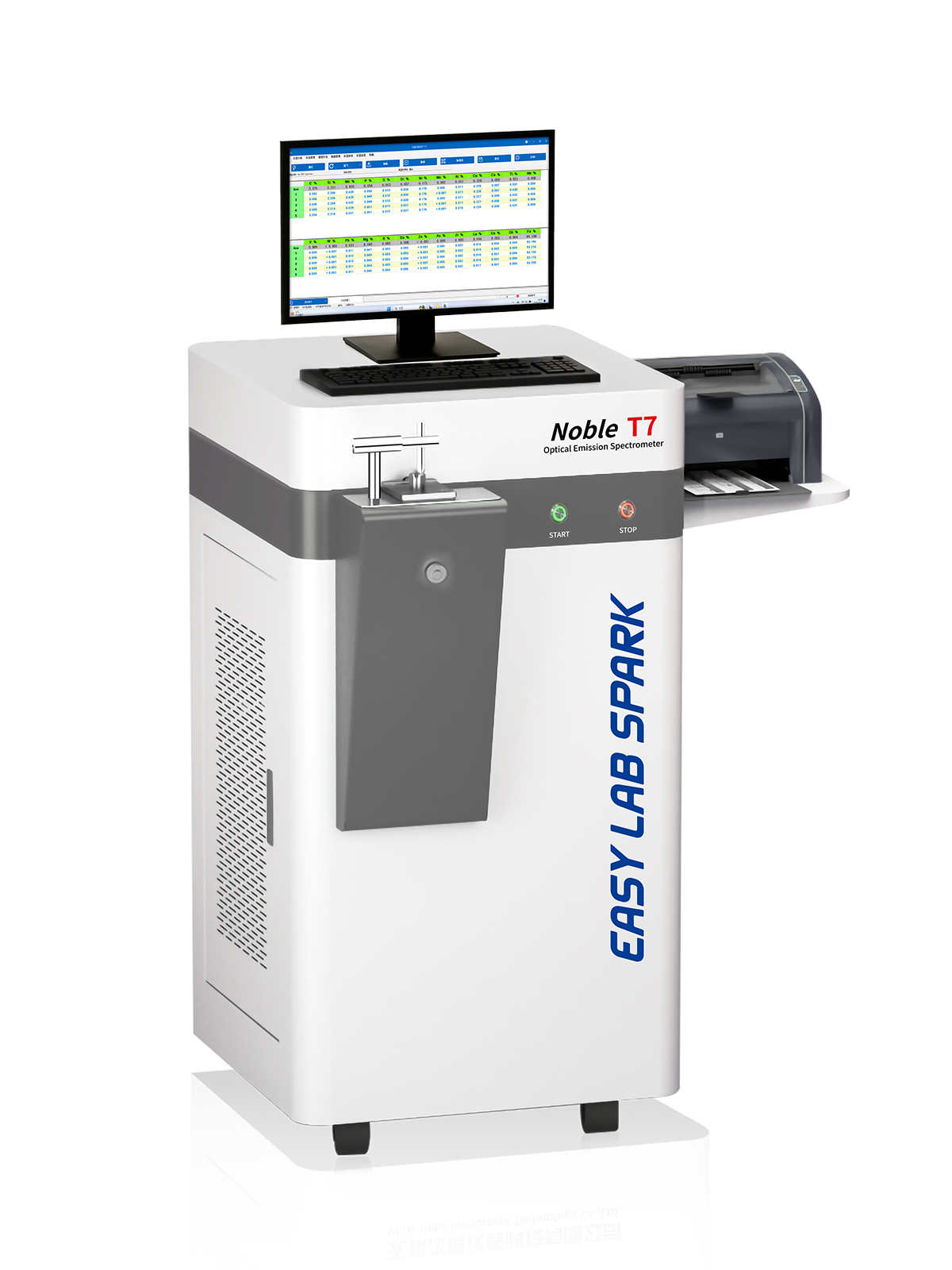
JIEBO-T7
Noble T7
Research-grade — constant-temp chamber (±0.1 °C), sub-10-ppm accuracy, 160 kg
Specifications
| Innovate T5 | Noble T7 | |
|---|---|---|
| Wavelength range | 140–680 nm | 120–800 nm |
| Optical system | Vacuum optical chamber | Constant-temperature chamber (±0.1 °C) |
| Detector | Hamamatsu CMOS, per-channel config | Research-grade CMOS, <10 ppm accuracy |
| Base matrices | Fe, Al, Cu, Mg, Zn, Ni, Co, Ti, Sn, Pb | Fe, Al, Cu, Mg, Zn, Ni, Co, Ti, Sn, Pb |
| Detection limit | Single-digit ppm with good calibration | Sub-10 ppm targeted, sub-ppm achievable |
| Dimensions (L × W × H) | 590 × 790 × 350 mm | 610 × 740 × 1140 mm |
| Weight | 78 kg | 160 kg |
| Best for | Production-floor QC, daily throughput | Research, certification, trace work |
When to choose which
Choose Innovate T5 when
- You run daily QC on iron, steel or non-ferrous casting and need a fast, compact instrument that fits in a 1 m² lab corner
- Detection at single-digit ppm is sufficient for your application (most foundry and recycling QC)
- Your team prefers a benchtop footprint and standard 78 kg single-person installation
- Your budget targets a high-volume production-floor analyzer, not a flagship lab instrument
Choose Noble T7 when
- You need trace-element detection below 10 ppm (aerospace QA, certification, R&D)
- Spectral position must remain stable across long shifts or 24/7 operation — the ±0.1 °C thermostat eliminates drift recalibration
- You analyze a wide variety of matrices and need the extended 120–800 nm window for elements outside the T5 range
- You have lab floor space and infrastructure for a 160 kg floor-standing instrument
Frequently asked questions
Do the T5 and T7 share calibrations and sample preparation methods?
Yes. Both use the same 401 mm Paschen-Runge optics and accept identical solid metal sample disks. Calibration curves built on one can be ported to the other with re-standardisation, and operator training transfers directly.
Can the T5 be upgraded to T7 performance later?
No — the wider wavelength range (120 nm vs 140 nm low end) and the constant-temperature chamber are hardware-level differences. A site upgrade is not offered; customers who outgrow the T5 typically keep it as a second-line instrument and add a T7.
Which model is preferred for aerospace and certification work?
The Noble T7. Trace-element requirements in aerospace (e.g. ASTM E1097, AMS specifications) usually demand sub-10 ppm reliability across long campaigns — the T7 thermostat is the deciding feature.
How much does argon consumption differ between the two?
Both run on argon 99.999 % (5N) at roughly 3 L/min during measurement. Total monthly consumption depends almost entirely on sample volume, not on which model is installed.