Compare · OES Spectrometers
Surpass F1 (Mobile OES) vs F7000 Pro (Handheld LIBS) — portable metal analyzer comparison
Both the Surpass F1 and F7000 Pro leave the lab — but they're portable in different ways. The Surpass F1 is a 45 kg cart-mounted spark OES with on-board argon and lithium battery: full ppm-level analysis including C, S, P, B, delivered next to the part. The F7000 Pro is a 1.25 kg handheld LIBS gun: lighter, faster, no argon and no ionizing radiation, but typical of laser physics it sees a narrower element set and is less accurate at low concentrations. The choice usually comes down to whether the field PMI needs certification-grade light-element data or whether sub-second alloy ID is enough.
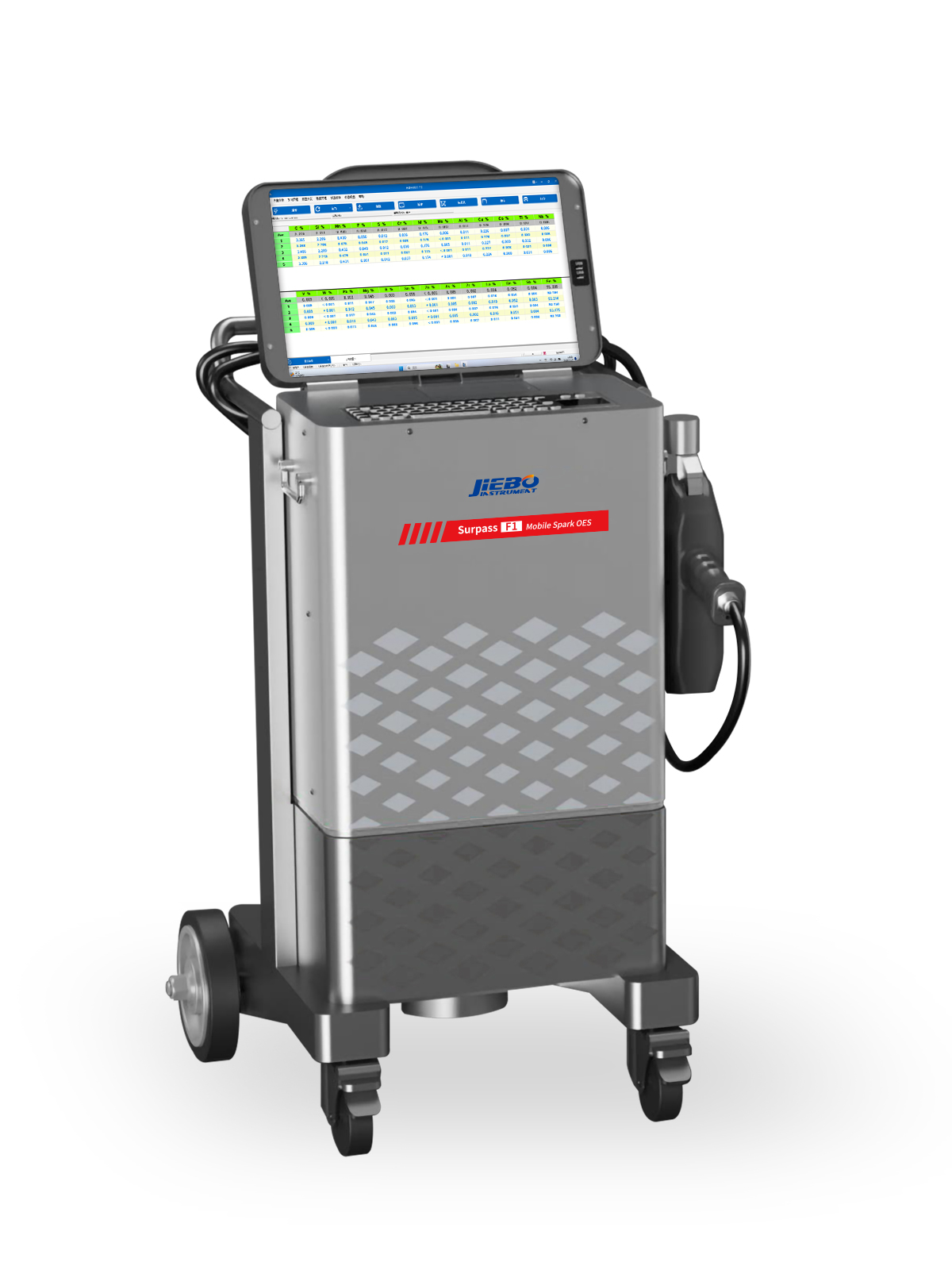
JIEBO-F1
Surpass F1 (Mobile OES)
Cart-mounted spark OES — 45 kg, lithium battery, reads C/S/P/B in the field
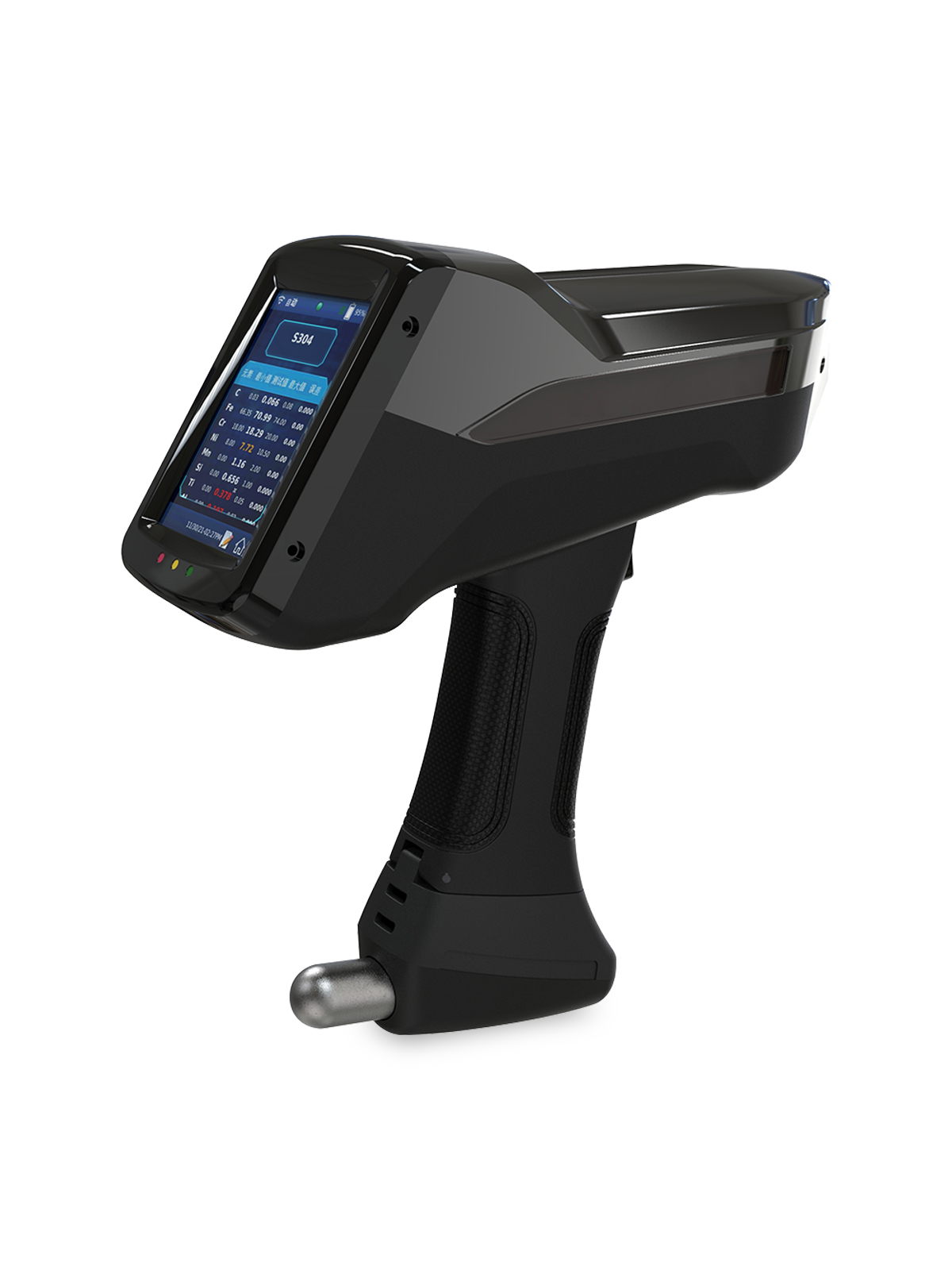
JIEBO-F7000
F7000 Pro (Handheld LIBS)
Handheld LIBS gun — 1.25 kg, Class 3B laser, sub-second readings, no argon
Specifications
| Surpass F1 (Mobile OES) | F7000 Pro (Handheld LIBS) | |
|---|---|---|
| Test methods | Spark optical emission (argon-purged probe) | Laser-induced breakdown spectroscopy (laser pulse) |
| Elements analyzed | Full periodic-table coverage including C, S, P, B, N | Be, Mg, Al, Si, Ti, Cr, Mn, Fe, Ni, Cu, Zn, Cd, Sn, Pb, Bi, Mo, V, Nb, W |
| Wavelength range | 160–425 nm (UV-extended for non-metals) | LIBS plasma emission (visible + near-UV) |
| Analyzing time | Tens of seconds per spark | < 1 s per measurement |
| Weight | 45 kg cart-mounted | 1.25 kg handheld |
| Argon purity | 5N argon required (on-board cylinder) | No argon — laser ablation in air |
| Battery | Built-in lithium, 600 wireless tests | Lithium battery, full shift handheld use |
| Best for | Field PMI requiring certification-grade C/S/P/B | Fast light-element alloy ID, walk-around inspection |
When to choose which
Choose Surpass F1 (Mobile OES) when
- Field PMI requires carbon, sulfur, phosphorus or boron at certification accuracy — these decide a steel grade and only spark OES reaches the necessary detection limits
- You inspect in-service pipework, large castings or pressure vessels and need lab-grade data without cutting the part
- You already operate spark OES in the lab and want the field workflow to use the same calibrations and reference materials
- A 45 kg cart-mounted footprint is acceptable — there is a path to roll the instrument to the part
Choose F7000 Pro (Handheld LIBS) when
- You need true walk-around portability — climbing, ladders, scaffolding, multiple inspection points per hour — a 1.25 kg gun fits where a 45 kg cart cannot
- Light-element ID is enough (Mg/Si in aluminum, Be in copper alloys) without certification-grade C/S accuracy
- Argon supply is impractical at the inspection site (remote field, regulatory or logistic constraints)
- Local rules favour non-radiation tools and your buyer prefers LIBS over handheld XRF for the same paperwork reason
Frequently asked questions
Why is mobile OES still considered "destructive" if I bring it to a pipe?
The argon-purged spark leaves a small burn pit on the surface, typically a few millimetres across. For most in-service PMI this is tolerable and removable by light grinding, but receiving inspections of finished customer-owned components sometimes prohibit it — in which case handheld XRF (no mark) is the cleaner choice.
How small is the LIBS laser mark by comparison?
Sub-millimetre, comparable to one OES spark. In practice both leave a visible mark on polished surfaces; LIBS is harder to see on industrial finishes.
Can the F7000 Pro hit the same accuracy as the Surpass F1 with more shots?
For light elements like Mg, Si, Al in aluminum alloys the gap narrows. For carbon, sulfur or trace elements at single-digit ppm, no — spark OES on a properly prepared sample is in a different accuracy class.
Which is harder to certify for export to my country?
Surpass F1: standard CE/CB; argon cylinder is the only logistics consideration. F7000 Pro: no nuclear regulator (advantage over XRF), but a Class 3B laser dossier and operator safety training are required. Neither is heavily restricted in major export markets.