
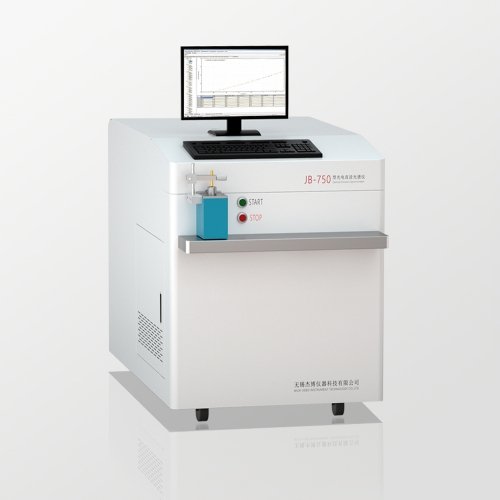
Product Overview
The JB-750 PMT Optical Emission Spectrometer is a high-performance stationary OES system engineered for laboratories and production environments that demand uncompromising analytical accuracy. Built around a machine-engraved concave grating with a 750 mm focal radius and photomultiplier tube (PMT) detection, the JB-750 achieves a repeatability of RSD 0.2% or better -- a benchmark that positions it among the most reliable instruments in its class.
Covering a wavelength range of 130 to 650 nm, the JB-750 handles the full elemental spectrum required for ferrous and non-ferrous metallurgy, from carbon and sulfur in ultra-low concentrations to major alloying elements. Its 36 standard analytical channels can be expanded to 64, giving laboratories the flexibility to grow their analytical programs without replacing the instrument.
Internally controlled thermal regulation maintains the optical system at 35 +/- 0.5 degrees Celsius, ensuring drift remains below 0.5% over an eight-hour shift. Combined with single-board computer control for streamlined operation and diagnostics, the JB-750 delivers the stability and throughput that high-volume testing environments require.
Key Features
Photomultiplier Tube Detection for Superior Sensitivity
PMT detectors remain the gold standard for optical emission spectrometry when ultimate sensitivity and dynamic range are paramount. Each channel in the JB-750 is equipped with a dedicated PMT, delivering signal-to-noise performance that enables reliable quantification of trace elements at parts-per-million levels.
High-Resolution Optical System
The machine-engraved concave grating features a 750 mm radius of curvature, a groove density of 1667 lines per millimeter, and a fixed incidence angle of 35 degrees. This optical configuration provides the resolving power necessary to separate closely spaced spectral lines, minimizing inter-element interference even in complex alloy matrices.
Precision-Controlled Thermal Environment
An internal thermoregulation system holds the spectrometer optics at 35 +/- 0.5 degrees Celsius regardless of ambient conditions. This eliminates thermally induced wavelength drift and ensures that calibration remains valid throughout extended production runs, with measured stability of less than 0.5% over eight hours.
Expandable Multi-Channel Architecture
The JB-750 ships with 36 pre-configured analytical channels and supports expansion to 64. Laboratories can add channels for new elements or additional analytical lines as their testing requirements evolve, protecting the initial capital investment over the long term.
Single-Board Computer Control
A dedicated single-board computer manages instrument operation, data acquisition, and calibration. This architecture reduces system complexity, shortens boot and measurement cycles, and simplifies maintenance by consolidating control electronics onto a single replaceable module.
Technical Specifications
| Parameter | Specification |
|---|---|
| Wavelength Range | 130 -- 650 nm |
| Grating Type | Machine-engraved concave grating |
| Grating Radius | 750 mm |
| Groove Density | 1667 lines/mm |
| Incidence Angle | 35 degrees |
| Detector | Photomultiplier Tube (PMT) |
| Standard Channels | 36 (expandable to 64) |
| Repeatability (RSD) | ≤ 0.2% |
| Long-Term Stability | < 0.5% drift over 8 hours |
| Internal Temperature Control | 35 +/- 0.5 degrees Celsius |
| Control System | Single-board computer |
Applications
Blast Furnace Process Control -- Real-time melt composition monitoring enables operators to adjust charge materials and flux additions during the smelt, reducing off-grade heats and lowering raw material costs.
Incoming Material Acceptance -- Verify that raw materials and semi-finished products meet purchase specifications before they enter the production process, preventing costly downstream quality failures.
Product Identification and Sorting -- Rapidly confirm alloy grades on finished and in-process inventory, supporting positive material identification (PMI) programs and preventing material mix-ups.
Quality Control and Certification -- Generate traceable analytical results for mill test reports, certificates of conformance, and internal quality records in compliance with customer and regulatory requirements.
Quality and Certifications
- ISO 9001 -- Quality Management System
- ISO 14001 -- Environmental Management System
- CE Marking -- European Conformity
- ROHS Compliant -- Restriction of Hazardous Substances
- SGS Certified -- Independent third-party verification
Frequently Asked Questions
What types of metals can the JB-750 analyze?
The JB-750 is designed for the analysis of ferrous metals (carbon steel, stainless steel, cast iron) and non-ferrous metals (aluminum, copper, nickel, cobalt, and other alloys). Channel configuration is tailored to the specific matrices and elements required by the customer.
How many elements can the JB-750 measure simultaneously?
With 36 standard channels, the instrument measures up to 36 elements in a single spark discharge. This can be expanded to 64 channels for laboratories that require a broader elemental suite.
What maintenance does the JB-750 require?
Routine maintenance includes cleaning the spark stand electrode, replacing argon purge filters, and periodic re-standardization using check samples. The internal temperature control system and single-board computer architecture minimize unscheduled downtime.
Does the JB-750 require argon gas?
Yes. High-purity argon (typically 99.999%) is used to purge the spark stand and optical path, which is essential for accurate measurement of elements with spectral lines in the vacuum ultraviolet region, including carbon, sulfur, and phosphorus.
What is the typical analysis time per sample?
A complete measurement cycle, including pre-burn and integration, typically takes 20 to 40 seconds depending on the analytical program and matrix. This supports the high sample throughput required in production control environments.