
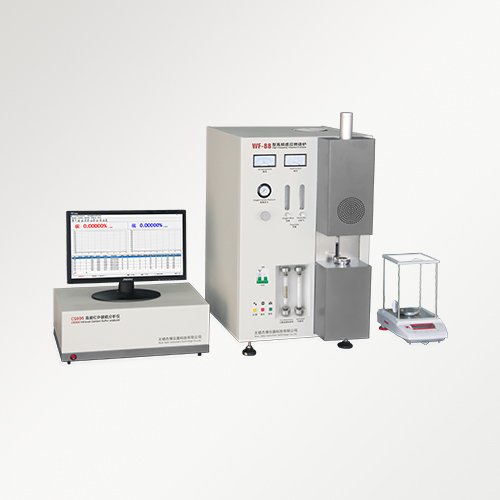
Product Overview
The CS995 High-Frequency Infrared Carbon Sulfur Analyzer is a robust, cost-effective instrument designed for high-throughput determination of carbon and sulfur in metals, alloys, ores, and other inorganic materials. Operating on the principle of high-frequency induction combustion followed by infrared absorption detection, the CS995 delivers a typical analysis cycle of approximately 35 seconds -- fast enough to support real-time production decisions on the shop floor.
The instrument measures carbon from 0.0005% to 6.0000% and sulfur from 0.0005% to 0.5000% in standard configuration, with both ranges extendable to 99.999% for specialized applications. A 20 MHz, 2.2 KVA high-frequency induction furnace ensures complete combustion of even refractory sample matrices, while a platinum infrared source, gilded analysis cell, and TSC infrared detector provide the signal stability and linearity required for reliable quantification at trace and percent levels alike.
With dual-CPU architecture and fully modular circuit design, the CS995 combines analytical performance with straightforward serviceability. It conforms to ISO 9556 for carbon determination and ISO 4935 for sulfur determination, giving laboratories the confidence that results are internationally recognized and defensible.
Key Features
High-Frequency Induction Combustion System
The 20 MHz, 2.2 KVA high-frequency furnace generates the intense, uniform heating needed to combust metallic and inorganic samples completely in an oxygen-rich environment. Complete combustion is the foundation of accurate infrared analysis; the CS995's power output ensures reliable results even with difficult-to-combust materials such as high-chromium steels and refractory ores.
Platinum IR Source and Gilded Analysis Cell
The infrared detection system pairs a long-life platinum infrared source with a gilded analysis cell that maximizes optical throughput and resists corrosion from combustion gases. This combination delivers stable, high-sensitivity infrared measurement over extended service intervals, reducing consumable costs and maintenance frequency.
TSC Infrared Detector with High Sensitivity
The TSC (thermally stabilized) infrared detector provides excellent signal-to-noise performance across the full measurement range, from sub-ppm trace levels to high-percentage concentrations. Constant-temperature operation eliminates detector drift, a common source of error in infrared analyzers operating in variable ambient conditions.
Dual-CPU Modular Architecture
Two independent processors manage instrument control and data processing, respectively. This separation improves system responsiveness and data integrity. The fully modular circuit board design allows individual subsystems to be replaced or upgraded without affecting the rest of the instrument, minimizing downtime during service.
Rapid Analysis Cycle
A typical carbon and sulfur determination is completed in approximately 35 seconds, with the full analysis window spanning 25 to 60 seconds depending on sample type. This throughput supports both high-volume production control and laboratory certification workflows without bottlenecks.
Technical Specifications
| Parameter | Specification |
|---|---|
| Carbon Measurement Range | 0.0005% -- 6.0000% (extendable to 99.999%) |
| Sulfur Measurement Range | 0.0005% -- 0.5000% (extendable to 99.999%) |
| Carbon Precision (RSD) | < 1% |
| Sulfur Precision (RSD) | < 1.5% |
| Typical Analysis Time | ~35 seconds (range: 25--60 s) |
| Sample Weight | 0.5 g |
| High-Frequency Generator | 20 MHz, 2.2 KVA output |
| IR Source | Platinum |
| Analysis Cell | Gilded |
| IR Detector | TSC infrared detector |
| Control System | Dual CPU, modular circuit design |
| Standards Compliance | ISO 9556 (Carbon), ISO 4935 (Sulfur) |
| Operating Temperature | 10 -- 30 degrees Celsius |
| Operating Humidity | < 75% RH |
Applications
Steel Mill Production Control -- Monitor carbon and sulfur content of heats in real time, enabling timely adjustments to steelmaking parameters and reducing the risk of off-specification material.
Foundry Melt Chemistry -- Verify carbon and sulfur levels in cast iron and steel melts prior to pouring, ensuring castings meet mechanical property requirements.
Incoming Raw Material Inspection -- Screen ferroalloys, scrap, and ores for carbon and sulfur content as part of incoming quality control procedures.
Quality Certification Laboratories -- Generate carbon and sulfur results that meet ISO 9556 and ISO 4935 requirements for inclusion in mill test reports and certificates of analysis.
Mining and Mineral Processing -- Determine carbon and sulfur in ores, concentrates, and geological samples to support exploration, process optimization, and environmental compliance.
Quality and Certifications
- ISO 9001 -- Quality Management System
- ISO 14001 -- Environmental Management System
- CE Marking -- European Conformity
- ROHS Compliant -- Restriction of Hazardous Substances
- SGS Certified -- Independent third-party verification
- Compliant with ISO 9556 and ISO 4935
Video Demo
Frequently Asked Questions
What sample types can the CS995 analyze?
The CS995 is designed for metals (steel, cast iron, copper alloys, nickel alloys), ferroalloys, ores, ceramics, and other inorganic materials.
How does the high-frequency combustion method work?
The sample is placed in a ceramic crucible with an accelerator (typically tungsten or iron/tin chips) and combusted in a stream of pure oxygen within the high-frequency induction furnace. Carbon is converted to CO2 and sulfur to SO2, which are then measured by the infrared detection system.
What consumables are required?
Primary consumables include ceramic crucibles, accelerator materials (tungsten, iron, or tin), and high-purity oxygen. The platinum IR source and gilded analysis cell are designed for long service life and are not considered routine consumables.
Can the measurement range be extended?
Yes. Both carbon and sulfur ranges can be extended to 99.999% by installing additional infrared detection cells optimized for high-concentration measurement.
What is the recommended calibration schedule?
JIEBO recommends verifying calibration with certified reference materials at the start of each shift or analysis session. Full recalibration is typically performed monthly or whenever consumable components are replaced.