
Product Overview
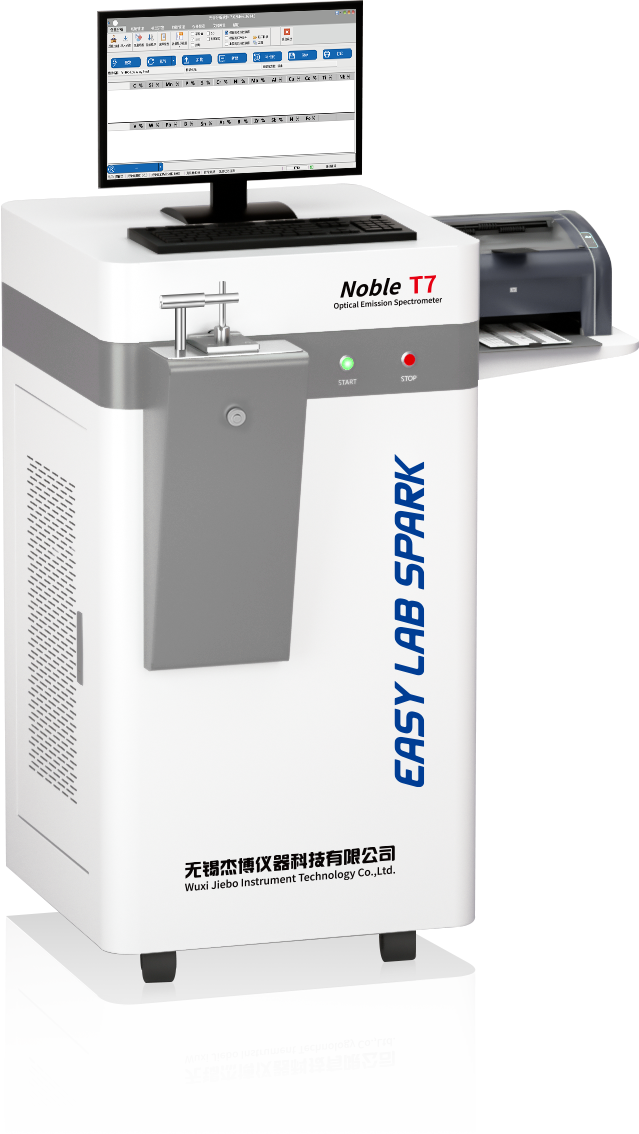
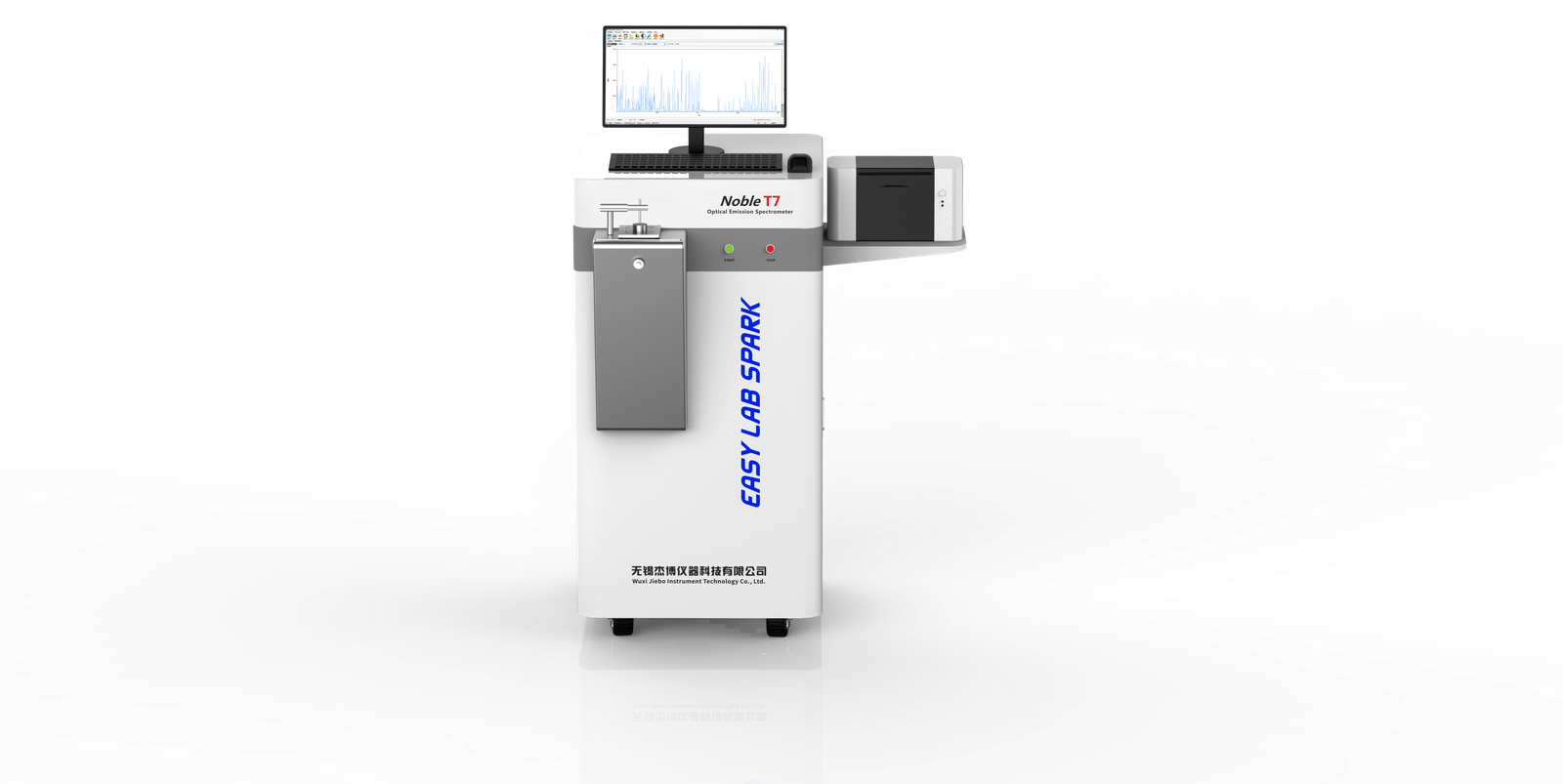
The JIEBO Noble T7 is a floor-standing optical emission spectrometer engineered for high-throughput production environments and advanced materials laboratories that require the widest possible elemental coverage without compromising speed or precision. Featuring a Para-Runge-Roland circular full-spectral vacuum optical system and a premium Hamamatsu CMOS array detector, the Noble T7 delivers complete analytical results in approximately 20 seconds across an industry-leading wavelength range of 120 to 800 nm.
The extended wavelength range of the Noble T7 sets it apart from conventional OES instruments. By reaching down to 120 nm in the vacuum ultraviolet, the T7 provides direct access to the primary analytical lines of carbon, phosphorus, sulfur, arsenic, boron, and nitrogen -- elements that are critical for metallurgical quality control but often require separate dedicated analyzers. Simultaneously, coverage up to 800 nm captures the full suite of metallic elements including alkali metals and certain rare earths that emit at longer wavelengths.
Automatic spectral line calibration and real-time drift correction ensure that analytical accuracy is maintained continuously, even across extended production shifts and fluctuating environmental conditions. The Noble T7 connects seamlessly to plant networks via Ethernet TCP/IP and supports Windows 7, 8, and 10 operating environments, enabling straightforward integration with existing laboratory information management systems (LIMS), ERP platforms, and production databases.
Key Features
Para-Runge-Roland Circular Vacuum Optical System
The Noble T7 employs a Para-Runge-Roland circular mount with a 401 mm focal length grating, optimized for uniform resolution and intensity across the full 120-800 nm wavelength range. The fully evacuated optical path eliminates UV absorption and spectral interference from atmospheric gases, delivering clean, high-resolution spectral data at every wavelength.
Hamamatsu CMOS Array Detector
At the heart of the Noble T7 is a premium CMOS array detector manufactured by Hamamatsu Photonics of Japan -- a recognized global leader in photonic sensing technology. This detector delivers exceptional quantum efficiency, low dark current noise, and high dynamic range, translating directly into superior detection limits and long-term measurement stability.
Complete Non-Metal and Metal Element Coverage
The Noble T7 detects carbon, phosphorus, sulfur, arsenic, boron, and nitrogen alongside all standard metallic alloying and trace elements. This eliminates the need for separate carbon/sulfur combustion analyzers or nitrogen/oxygen analyzers for routine compositional analysis, consolidating your analytical workflow into a single instrument.
Automatic Spectral Line Calibration and Drift Correction
Built-in algorithms continuously monitor reference spectral lines and apply real-time corrections for thermal drift, mechanical settling, and long-term optical changes. This automated system maintains calibration accuracy without manual intervention, reducing operator workload and ensuring consistent data quality across shifts and seasons.
20-Second Full Analysis Cycle
From spark initiation to final reported results, the Noble T7 completes a full multi-element analysis in approximately 20 seconds. This rapid cycle time supports high-throughput production environments where furnace hold times, melt scheduling, and shipping deadlines demand fast turnaround without sacrificing analytical rigor.
Flexible Sample Handling with Universal Clamp
The 13 mm sample hole is paired with a flexible clamping system that accommodates a wide range of sample geometries, from standard coupons and pins to irregularly shaped production parts. This versatility reduces the need for extensive sample preparation and supports a broader range of real-world analytical scenarios.
Technical Specifications
| Parameter | Specification |
|---|---|
| Optical System | Para-Runge-Roland circular full-spectral vacuum mount |
| Detector | CMOS array (Hamamatsu, Japan) |
| Wavelength Range | 120 -- 800 nm |
| Grating Focal Length | 401 mm |
| Discharge Frequency | 100 -- 1000 Hz |
| Maximum Discharge Current | 400 A |
| Ignition Pulse Voltage | 1 -- 14 kV |
| Argon Purity | 99.999% |
| Argon Inlet Pressure | 0.5 MPa |
| Argon Flow (Excitation) | 3.5 L/min |
| Argon Flow (Maintain) | 0.4 L/min |
| Argon Flow (Standby) | 0.1 L/min |
| Sample Hole Diameter | 13 mm |
| Sample Clamp | Flexible universal clamp |
| Analysis Time | Approximately 20 seconds |
| Detectable Elements | C, P, S, As, B, N + all metal elements |
| Calibration | Automatic spectral line calibration with drift correction |
| Dimensions (W x D x H) | 760 x 610 x 1130 mm |
| Weight | 168 kg |
| Power Supply | 220 +/- 20V AC, 50/60 Hz |
| Power Consumption | 1200 W |
| Connectivity | Ethernet TCP/IP |
| Operating System | Windows 7 / 8 / 10 |
Applications
Steel Mill Furnace Control -- Deliver rapid melt composition data during electric arc furnace, basic oxygen furnace, and induction furnace operations. The 20-second cycle time supports real-time alloying adjustments and minimizes costly furnace hold times.
Foundry Process Control -- Monitor iron, steel, aluminum, and copper alloy compositions throughout the casting process, from charge makeup through final pour verification, ensuring every heat meets specification.
Non-Metallic Element Screening -- Directly measure carbon, sulfur, phosphorus, nitrogen, arsenic, and boron in a single spark analysis without auxiliary combustion or fusion analyzers, streamlining laboratory operations and reducing capital expenditure.
Aerospace and Defense Materials Qualification -- Support stringent material certification requirements for superalloys, titanium alloys, and specialty steels where trace element control at parts-per-million levels is critical to component performance and regulatory compliance.
Scrap Sorting and Recycling Operations -- Rapidly identify and classify incoming scrap metals by grade, supporting accurate valuation, efficient sorting, and contamination prevention in secondary smelting operations.
Research and Alloy Development -- Leverage the wide 120-800 nm wavelength range and high resolution to characterize experimental alloy compositions, study trace element effects, and support new material development programs.
Quality and Certifications
The Noble T7 is manufactured in JIEBO's ISO 9001-certified production facility using precision-ground optical components, climate-controlled assembly processes, and comprehensive end-of-line testing.
- ISO 9001 -- Quality Management System
- ISO 14001 -- Environmental Management System
- CE Marking -- European Conformity
- ROHS Compliant -- Restriction of Hazardous Substances
- SGS Certified -- Independent third-party verification
What's Included
- Noble T7 spectrometer main unit with integrated stand
- Digital spark source and electrode assembly
- Flexible universal sample clamp
- Argon gas regulator, tubing, and fittings
- Factory calibration reference sample set
- Multi-point calibration certificate
- Power cable and grounding kit
- Ethernet network cable
- Software installation media, license key, and user guide
- Instrument operation and maintenance manual
- Starter consumable electrode pack
Frequently Asked Questions
What is the advantage of the 120-800 nm wavelength range compared to standard OES instruments?
Most conventional OES instruments cover approximately 160-500 nm or 170-680 nm. The Noble T7's extended range down to 120 nm provides access to the most sensitive analytical lines for carbon, nitrogen, sulfur, and phosphorus in the deep vacuum UV, while coverage up to 800 nm captures alkali metals and certain rare earth elements that emit at longer wavelengths.
Can the Noble T7 replace a dedicated carbon/sulfur combustion analyzer?
For many routine production control applications, yes. The Noble T7 provides direct spark-based measurement of carbon and sulfur with detection limits suitable for most standard alloy specifications. However, for ultra-trace carbon and sulfur analysis at single-digit ppm levels, or for analysis of non-metallic samples, a dedicated combustion analyzer may still be required.
How does the automatic drift correction work?
The instrument's software continuously monitors the positions and intensities of known reference spectral lines from internal standards. When deviations are detected due to thermal expansion, mechanical settling, or gradual optical changes, the system automatically applies wavelength and intensity corrections in real time.
What sample preparation is required?
Samples must present a clean, flat metallic surface that fully covers the 13 mm spark aperture. Typical preparation involves grinding or milling the sample face to remove oxide layers, casting skin, or surface contamination. The flexible clamp system accommodates various sample shapes and sizes.
What are the argon consumption costs?
The Noble T7 uses a three-tier argon management system. During active sparking, flow is 3.5 L/min. Between analyses in maintain mode, flow drops to 0.4 L/min. In standby, consumption is just 0.1 L/min. Over a typical 8-hour shift with moderate analysis frequency, total argon consumption is significantly lower than instruments that maintain full flow continuously.
Does the Noble T7 integrate with existing IT infrastructure?
Yes. The Noble T7 connects via standard Ethernet TCP/IP and operates on Windows 7, 8, or 10. The software supports data export in common formats and can interface with LIMS, ERP platforms, and plant-level databases. Custom integration support is available.