
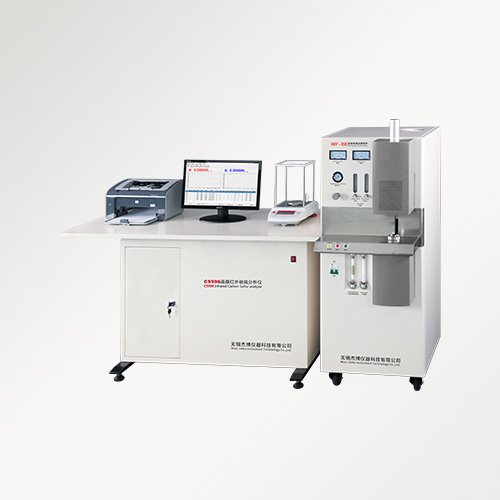
Product Overview
The CS996 High-Frequency Infrared Carbon Sulphur Analyzer represents the next level of performance in JIEBO's carbon and sulphur analysis portfolio. With a carbon measurement range starting at 0.0001% and extending to 10.0000%, and a sulphur range from 0.0001% to 3.5000%, the CS996 covers a significantly broader analytical window than entry-level instruments -- making it suitable for both ultra-low-carbon specialty steels and high-sulphur materials in a single platform.
Precision is where the CS996 distinguishes itself most clearly. Carbon repeatability of RSD less than 0.5% and sulphur repeatability of RSD less than 1% place this instrument in the upper tier of combustion-IR analyzers, meeting the demands of certification laboratories, research facilities, and producers of premium-grade materials where tighter tolerances translate directly to product quality and market value.
The CS996 incorporates separate low-carbon and high-carbon infrared detection pools, with an optional high-sulphur pool available for laboratories that routinely analyze materials with elevated sulphur content. This multi-pool architecture eliminates the compromises inherent in single-detector designs, ensuring optimal sensitivity and linearity across the full concentration range. The instrument complies with ISO 9556 for carbon and ISO 4935 for sulphur.
Key Features
Separate Low and High Carbon Detection Pools
Rather than relying on a single infrared cell to span the entire carbon range, the CS996 employs dedicated low-carbon and high-carbon detection pools. Each pool is optimized for its respective concentration range, delivering better linearity, lower detection limits at the trace end, and greater accuracy at high concentrations.
Optional High Sulphur Detection Pool
For applications involving materials with sulphur concentrations above the standard range -- such as free-machining steels, certain ores, or sulphide-rich minerals -- an optional high-sulphur pool can be installed.
Industry-Leading Carbon Precision
With carbon repeatability of RSD less than 0.5%, the CS996 meets the stringent requirements of laboratories producing certified reference materials, qualifying new steel grades, or resolving disputes over marginal results.
Extended Measurement Range from a Single Platform
Carbon from 0.0001% to 10.0000% and sulphur from 0.0001% to 3.5000% in standard configuration -- both extendable to 99.999% -- mean that the CS996 handles virtually any inorganic sample matrix without requiring a second instrument.
Technical Specifications
| Parameter | Specification |
|---|---|
| Carbon Measurement Range | 0.0001% -- 10.0000% (extendable to 99.999%) |
| Sulphur Measurement Range | 0.0001% -- 3.5000% (extendable to 99.999%) |
| Carbon Precision (RSD) | < 0.5% |
| Sulphur Precision (RSD) | < 1% |
| Analysis Time | 25 -- 60 seconds |
| Sample Weight | 0.5 g |
| Detection Pools | Separate low/high carbon; optional high sulphur |
| Standards Compliance | ISO 9556 (Carbon), ISO 4935 (Sulphur) |
Applications
Ultra-Low-Carbon and IF Steel Production -- Accurately measure carbon at concentrations as low as 0.0001%, supporting the production and certification of interstitial-free (IF) steels.
High-Carbon and Cast Iron Analysis -- With a carbon range extending to 10%, the CS996 handles high-carbon steels, white and grey cast irons, and ductile iron without range limitations.
Free-Machining Steel Sulphur Control -- The optional high-sulphur pool enables reliable measurement of sulphur in free-machining grades.
Research and Development -- The sub-0.5% RSD carbon precision supports R&D laboratories developing new alloy compositions.
Third-Party Testing and Certification -- Meet the analytical performance requirements expected by accreditation bodies and end customers.
Quality and Certifications
- ISO 9001 -- Quality Management System
- ISO 14001 -- Environmental Management System
- CE Marking -- European Conformity
- ROHS Compliant -- Restriction of Hazardous Substances
- Compliant with ISO 9556 and ISO 4935
Frequently Asked Questions
How does the CS996 compare to the CS995?
The CS996 offers wider measurement ranges (carbon starting at 0.0001% vs. 0.0005%, sulphur up to 3.5% vs. 0.5%), better carbon precision (RSD <0.5% vs. <1%), and the option of a dedicated high-sulphur pool.
What is the benefit of separate low and high carbon pools?
Separate pools allow each infrared cell to be optimized for a specific concentration range. The low-carbon pool provides maximum sensitivity for trace-level measurements, while the high-carbon pool provides accurate readings at percent-level concentrations without signal saturation.
Can I add the high sulphur pool after initial purchase?
Yes. The high sulphur pool is a field-installable option. Contact JIEBO technical support to discuss retrofit installation and recalibration.
What oxygen purity is required?
A minimum oxygen purity of 99.5% is recommended, with 99.9% or higher preferred for trace-level carbon and sulphur measurements.
What accelerator materials does the CS996 use?
Standard accelerator options include tungsten, iron, and tin chips. The choice depends on the sample matrix and the elements of interest.